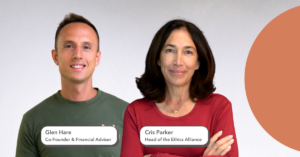
In the latest episode of our Ask the Experts series, Glen chats with Cris Parker, Head of the Ethics Alliance, to reveal how our ethics shape our decision-making in business, finance and life.
Do you know how Crypto mining works and the impact it has on the environment? Looking at Bitcoin alone, its energy usage has resulted in the currency having the same annual carbon footprint as Argentina! Does profit over the planet align to your core values and what is your responsibility as a consumer?
In this Ask The Experts session, we were thrilled to be joined by ethics expert, Cris Parker. Cris heads up The Ethics Alliance, a community of organisations that work to collaboratively to shape the future of business ethics.
She is also a director of The Banking & Finance Oath, a pledge of integrity and commitment that aims to increase consideration of stakeholders and decision-making accountability by financial service professionals.
In this conversation, Glen and Cris covered a bunch of topics including:
- Why ethics impact our decision making
- How our choices connect to both our personal and financial lives
- Top tips and tools to explore your personal values and challenge your ethics
- How trends such as investing in Crypto challenge profit vs planet + more!
How do our values impact our decision-making?
We chat a lot about values with our members at Fox & Hare because we’re a big believer in making decisions in all aspects of life that align with what’s important to us. This ensures we’re putting our time, money and attention towards things that truly fulfil us.
Cris points out that many of us don’t have that clear picture of what’s really important to us as a starting point.
“If you want to determine your values, start by thinking of those times where you felt happy, fulfilled and satisfied. Then ask yourself: what made you feel that way? That is a good way to determine what you value, “ tells Cris.
What are the ethical considerations when investing in Cryptocurrency?
There’s been plenty of discussions about Cryptocurrency in the past few years as a new investment opportunity but when it comes to ethics, how can we tell if Crypto aligns with our values?
“It’s worth considering the amount of energy that it takes to mine things like Bitcoin. Back in 2011 you could just use a laptop to mine Bitcoin. Now, you need rooms of computers to do that,” reveals Cris.
To put that in practical terms: Bitcoin uses the same amount of energy as the entire country of Poland every single day. If you’re passionate about sustainability and the future of our planet, it’s worth considering if this high-energy usage really aligns with your values before investing in it.
Are more of us making decisions with ethics in mind?
For those of us living in the inner city, it’s hard to walk down the street or head to the movies without seeing an ad about “ethical” investing or businesses but how widespread is the take-up of ethical decision making?
Cris reveals that bigger social issues (such as climate change and the Black Lives Matter movement) are giving everyday people a newfound awareness of ethics and how it impacts our day-to-day lives.
“Historically, ethics has been used as a mechanism to call out bad behaviour. But that’s changing,” tells Cris.
Now, more of us are feeling comfortable talking about ethics. The more ‘normal’ ethics becomes, the more socially acceptable it is to question our biases and blind spots, and the greater our collective expectation is for others to do the same (including businesses).
What business sectors do you feel are leading the way in ethical decision-making?
As Cris explains, many businesses are making their commitment to social and ethical decision-making visible to consumers. “When you’re investing now, a lot of organisations are very transparent about their commitment to social and ethical responsibility,” tells Cris.
However, she caveats that by saying that there’s no set standards to measure businesses’ ethical requirements up against, leaving plenty of room for variety.
“I do think financial services more broadly are making a strong effort because they want to be seen as living up to their values and commitment to ethics,” tells Cris.
Cris points out that it’s important to do our own research and investigate whether businesses are truly acting ethically. Unfortunately, ‘greenwashing’ can fool us into thinking that businesses are doing good, while still conducting themselves in ways that aren’t socially or environmentally responsible.
Our top takeaway points
- Every choice we make should be a reflection of our values: from what organisation we work for to where we invest our Super, each decision we make needs to be aligned with our ethics and what’s important to us.
- When investing, check what an organisation’s values are and whether they’re living up to them: as consumers, we have the right to question and hold companies accountable to their said values and mission statements (and don’t be afraid to take your money elsewhere if you’re not happy with their response).
- Remember that your purchasing power can be a force for good: all of us have the ability to use our money to make the world a better place. Whether that’s switching to a renewable energy provider, finding a truly ethical super fund or even swapping to recycled toilet paper, your dollar can make a difference.
Want to learn how you can invest in-line with your ethics? Click here to book in for a quick chat. ?
Read more insights from our experts
How Australia’s #1 Property Agent Seals the Deal
You could say that buying property is Australia’s national sport. And you could also say that most Australians are playing it like a game...
The Budget, $1,000,000, Emergency Funds and more: Julies on Equity Mates!
Fox & Hare financial adviser, Julie Bullen, recently joined the Equity Mates Investing Podcast to tackle the hard questions from their community. Hot on...
Emergency Town Hall: What’s Jim Doing with the Budget?
Mission-Critical or Media Noise? Financial freedom should be defined by your strategy, not the changing whims of the political cycle. Last week,...
Interior Design Decoded: Your Framework for a Beautiful, Functional Home.
The Cost vs. The Joy of Living Australia is a nation of property addicts. We talk about buying property, we talk about renting...
From Big Firms to Big Dreams: How Maira Engineered Her Corporate Exit.
The architecture of financial freedom. In short: Walking away from a secure income is terrifying, especially with a family and a mortgage – but...